Skip to content

Salesforce · Integrations
Document intelligence

We engineer the systems other companies run their business on.

Synairo is two senior engineers in Warsaw. We design and build Salesforce architecture, enterprise integrations, and document intelligence for our clients - and we build and operate our own software with the same hands.

The teamWarsaw, PL
Michał Targiel and Marcin Jeziorek, the two engineers who make up Synairo, seated together in their Warsaw office.

Michał Targiel and Marcin Jeziorek - the two engineers who do the work.

Company
Two senior engineers. The people you meet are the people who build it.
Based
Warsaw, Poland - Central European time, working in English and Polish.
Also
We build and operate our own software: DocSolved.ai.
02What we engineer

Three disciplines, and the seams between them.

Most of our work sits where these overlap: a Salesforce org that has to stay in step with an ERP, or a document process that has to end in a record someone will be audited on. We take the whole seam rather than one side of it.

02

Enterprise integrations

Interfaces between Salesforce and the systems that own the data - designed for the day they fail, not just the day they ship.

  • System-of-record boundaries
  • Idempotency and redelivery
  • Failure paths as first-class design
How we approach it →
03

Document intelligence

Turning documents into structured records you can audit - extraction with confidence scores, source evidence, and a review path for anything uncertain.

  • Verification before accuracy
  • Where the human belongs
  • Structured formats are not OCR problems
How we approach it →
04

Salesforce ERP integration

Design, review, remediate, or build Salesforce-to-ERP interfaces with explicit ownership, failure handling, and production monitoring.

  • Commercial vs informational intent
  • Delivered experience vs capability
  • Production readiness means operability
How we approach it →

The seam, drawn out.

A worked reference architecture rather than an illustration: three systems, what each one owns, and what it puts on the wire. This is the artefact we produce first on an integration engagement, filled in with your systems.

Enterprise integrations →
Reference architecture · bidirectional interface
  1. Salesforce

    System of record for

    Opportunity, Quote, Account relationship

    Writes an outbound event on state change

  2. Integration layer

    Owns

    Mapping, sequencing, retry state

    Deduplicates on a stable business key

  3. ERP

    System of record for

    Order, Invoice, Pricing, Stock

    Returns an acknowledgement with its own identifier

Generic reference architecture. The actual interfaces, ownership matrix, and operating responsibilities are defined per engagement during discovery.

03Software as proof

We ship our own software, so you can inspect how we build.

A consultancy can describe its standards. A product has to survive contact with real documents and real users. These are ours - designed and built by the same engineers who do the client work.

DocSolved.ai

Live

Documents in. Predictable data out.

Document extraction for automation workflows: structured fields with source checks and confidence, Ready vs Review required routing, and delivery by API, webhook, or export. Pricing and policies live on docsolved.ai.

  • Field-level source checks and confidence on extracted values
  • Ready vs Review required status per document
  • Structured e-invoice XML first: Factur-X, ZUGFeRD, KSeF FA(3), UBL 2.1 (read from XML, not OCR)
Extraction result · output structurereview below 0.80
Illustrative extraction output showing each field with its value, confidence score, and source location on the document.
FieldValueConfidenceSource evidence
supplier.nameNorthwind Components BV0.99p.1 · 62,118 · 214×18
invoice.numberINV-2026-0044710.98p.1 · 431,96 · 132×16
invoice.issueDate2026-03-040.96p.1 · 431,124 · 96×16
total.net18 420.00 EUR0.97p.2 · 388,642 · 118×18
total.vat3 868.20 EUR0.94p.2 · 388,668 · 110×18
paymentTerms30 days net0.61p.2 · 64,712 · 176×16

The last row is the point. paymentTerms scored below the review threshold, so it is flagged for a person instead of being written silently - and the source column means checking it takes one click, not a document hunt.

Illustration of the output structure - field, value, confidence, and source coordinates - using an invented document. Not a screenshot, not a benchmark, and not an accuracy claim.

ScanForce Open

Open source · Apache-2.0

Open-source document processing for Salesforce

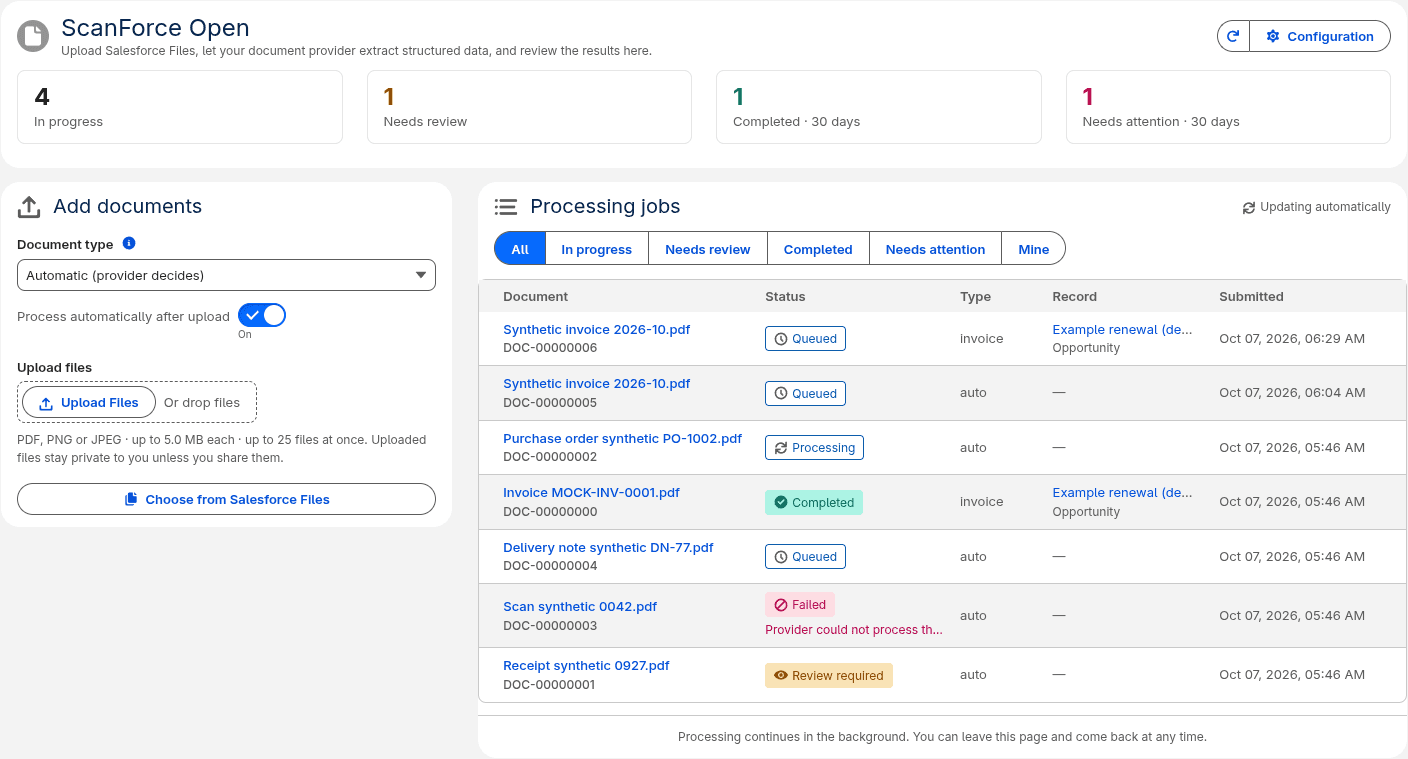
A Salesforce-native workspace that submits Salesforce Files to a document-processing provider you choose, tracks job state, supports human review, and can write extracted values back to linked records. Apache-2.0, installed from source.

  • Upload PDFs and images or select existing Salesforce Files
  • Asynchronous processing with Queued, Processing, Completed, Review Required, Failed, and Timed Out states
  • Display extracted fields and line items; preview and apply values to linked Salesforce records
ScanForce Open workspace listing document processing jobs across queued, completed, failed, and review-required states
Salesforce-native workspace. Extraction runs in a provider you configure - DocSolved.ai or any compatible /connect/v1 backend.
04Selected engineering work

What we have actually delivered - and what we will not claim.

We do not publish client names, logos, or outcome numbers without written approval and a figure we can stand behind. Neither exists yet, so this section shows only what we can evidence - delivered team experience, and the software above that runs today.

Delivered experience on file
  • SAP

    Team experience

    Delivered pattern · Historical delivery

    Synairo has team-level delivery experience with Salesforce and SAP/ERP integrations. Each implementation depends on the customer's SAP product, interfaces, and operating model.

The product above is also delivered work, designed, built, and operated by the same engineers: DocSolved.ai is live today.

Systems we work with - capability catalogue →

“Team experience” means we have delivered this pattern and can point to the engineer who did. Systems we can design against but have no delivered reference for are listed on the solutions page, marked as capability rather than delivery. None of these are prebuilt connectors.

Why there are no logos on this page

A logo wall usually means one of three things: an approved reference, one small piece of work dressed up as a partnership, or a mark nobody asked permission to use. Only the first is worth anything to you, and it takes the longest to get. Until a case study is approved and has a result we can state honestly, this space stays empty rather than getting filled.

In the meantime: ask us in a call. We will talk through specific systems we have integrated and problems we have fixed, and arrange a reference conversation under NDA where the client agrees to one.

Ask for a reference conversation →
05How we approach production systems

Anything can be demonstrated. Production is a different problem.

These are the practices we apply, not guarantees we sell. Service levels, acceptance criteria, and operational responsibilities belong in a project scope agreed with you - not in a bullet list on a website.

  1. 01

    Decide ownership before writing code

    Which system owns which field, in which direction, and who resolves a conflict. Written down per field, because every argument in year two resolves back to it.

  2. 02

    Design the failure path with the happy path

    Retry policy, backoff, dead-letter destination, and replay tooling are part of the interface specification. A message that cannot be processed has to land somewhere a person can see it.

  3. 03

    Make redelivery boring

    Stable business keys and idempotent writes, so a retried message is a no-op rather than a duplicate record. This is the single control that prevents most integration incidents.

  4. 04

    Detect divergence instead of assuming consistency

    A reconciliation job that compares both sides on a schedule will find the drift an interface quietly introduced. Without one, you learn about it from a customer.

  5. 05

    Instrument for the person who gets paged

    Logging is designed around what a first responder needs to answer: what failed, for which record, and what to do next. Volume of logs is not the same as observability.

  6. 06

    Name an owner on both sides

    An interface without a named owner at each end degrades quietly. We agree who watches the error queue and who can prioritise a fix, during design rather than after the first incident.

06Engineering notes

What we have had to work out, written down.

Notes from delivery, not content marketing. Each one names the engineer who wrote it and cites the primary documentation it relies on, so you can check the reasoning rather than take it on trust.

All engineering notes →
07People

Two engineers. There is no one behind them.

No account layer, no delivery pod, no offshore second team. The person who scopes the work is the person who writes it and the person who answers when it breaks. That is the whole company, and it is the reason we take a narrow set of problems.

Formal Salesforce and MuleSoft certifications are named in full on each engineering profile.

Michał Targiel

Salesforce Tech Lead & Integration Specialist

On an engagement

  • Designs and writes the integration layer between Salesforce and the customer’s systems of record
  • Owns the error, retry, and replay behaviour that keeps interfaces recoverable in production
  • Builds and operates DocSolved.ai, including extraction, source checks, and review routing
08Direct contact

Write to us, and an engineer writes back.

Not a form that routes to a sales queue. The address below reaches both of us, and the reply comes from whichever of us knows the answer. We typically respond within one business day.

What makes a first message useful

  • The system or systems involved, and which one currently owns the data
  • What is breaking, or what you are trying to stand up
  • Any fixed constraint: a deadline, an audit, a platform you cannot change

If it is not something we should take on, we will say so and tell you what we would look for instead. Please do not send credentials, customer data, or confidential documents in a first message.