News · Salesforce
What Salesforce joining Poppy means for Commerce Cloud
Salesforce joined the Personal Agent Protocol as a launch partner on 16 November 2026. Not a Commerce Cloud switch. Four decisions to settle first.
- Written by
- Synairo editorial
- Published
- · updated
- Reported event
- Reading time
- 11 min read
Short answer
On 16 November 2026, Salesforce said it had joined the Personal Agent Protocol (Poppy) as a launch partner. Sierra and Meta had published version 1.0 of that open standard on 13 November 2026. Poppy covers how a personal agent finds a store, proves its identity, and, with the shopper's consent, signs into their account. Cart, checkout, payment, and orders are handed to the Universal Commerce Protocol (UCP). Salesforce says UCP is already part of Commerce Cloud, and that it intends to bring Poppy onto that foundation. It has not given a date or a product scope.
What is the Personal Agent Protocol?
The Personal Agent Protocol, or Poppy, is an open standard for how a shopper's own AI agent works with a business. In its 16 November 2026 announcement (opens in a new tab), Salesforce describes the problem the standard is meant to address: shoppers are starting to send agents to find products, compare prices, reorder everyday items, and check deliveries, and those agents can work across every brand a shopper buys from. Merchants then have to decide how to welcome an agent they have never met without giving up control of the store or the customer relationship.
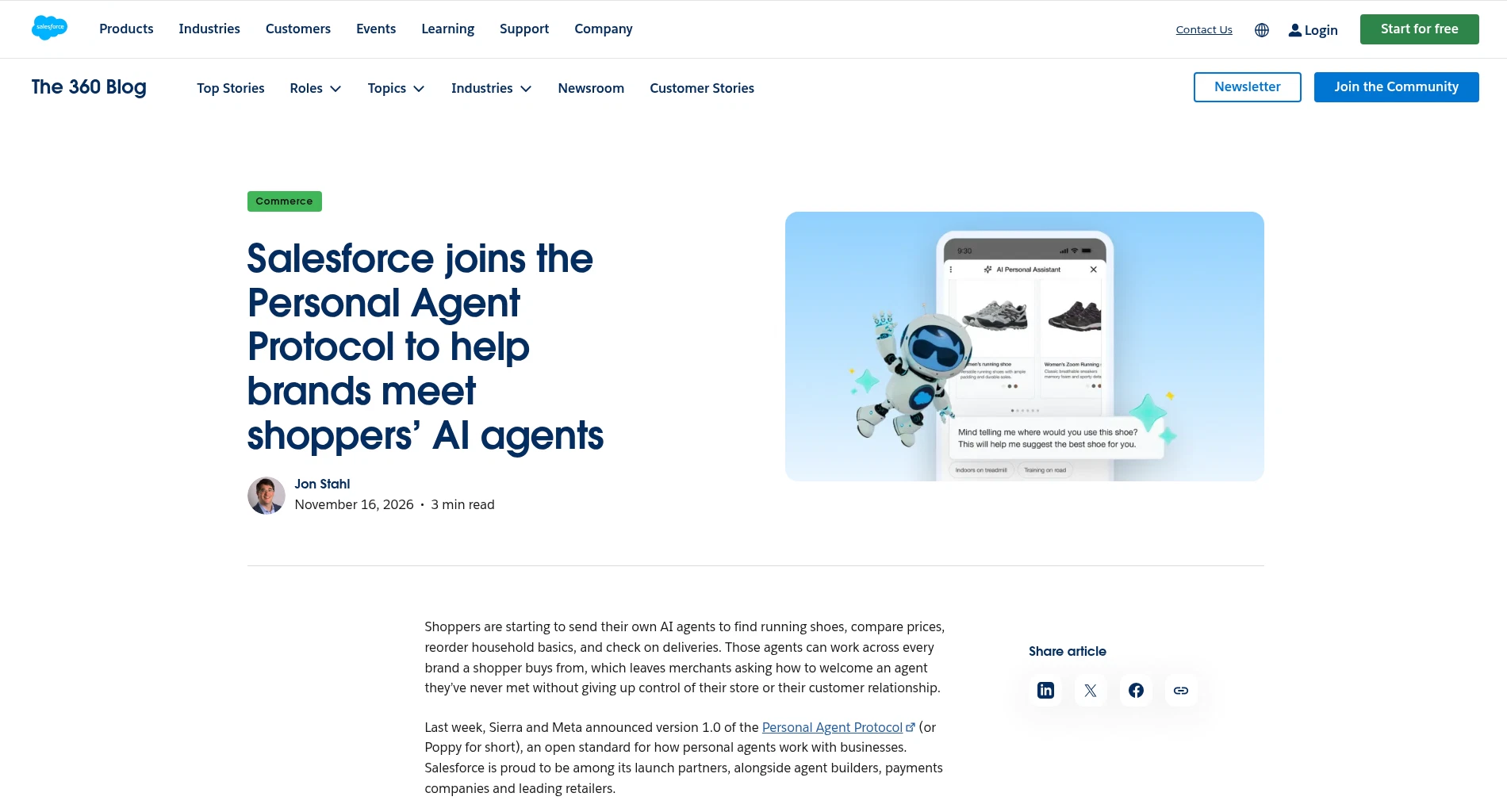
Source: Salesforce, The 360 Blog, Nov 16, 2026. salesforce.com/blog/salesforce-joins-personal-agent-protocol (opens in a new tab)
In Salesforce's account, Poppy is the front door. The agent finds the store, identifies itself with a digital signature, and, if the shopper agrees, signs in. The standard is deliberately not a complete commerce stack. Transactional steps sit on the other side of a handoff.
Sierra and Meta, which published version 1.0 on 13 November 2026 (opens in a new tab), describe the same split in slightly broader terms: Poppy is what happens when an agent arrives, says who it is, and finds out what it is allowed to do; the Universal Commerce Protocol (UCP) handles the shopping itself. Their posts also name existing building blocks such as MCP, OpenAPI, and OAuth, and they point implementers to a public protocol site. Those details are theirs, not Salesforce's, and they are not evidence that any of those mechanisms already exist as Commerce Cloud product features.
The useful move for an architect is to take the protocol as a description of an arrival path, not as a substitute for the ownership, consent, and failure design you would already demand of any new channel.
How do Poppy and the Universal Commerce Protocol fit together?
Salesforce draws a clean boundary. Poppy covers find, identify, and sign in. When the visit reaches cart, checkout, payment, or orders, Poppy hands the work to UCP. Salesforce describes UCP as an open standard built by Google with industry partners, governing how a merchant and an agent transact, and says this protocol already powers agentic checkout in Google's AI experiences, with the brand as merchant of record and orders flowing into the systems brands already run. That last point is Salesforce's description of UCP in production at Google, not a statement about a Poppy implementation in Commerce Cloud.
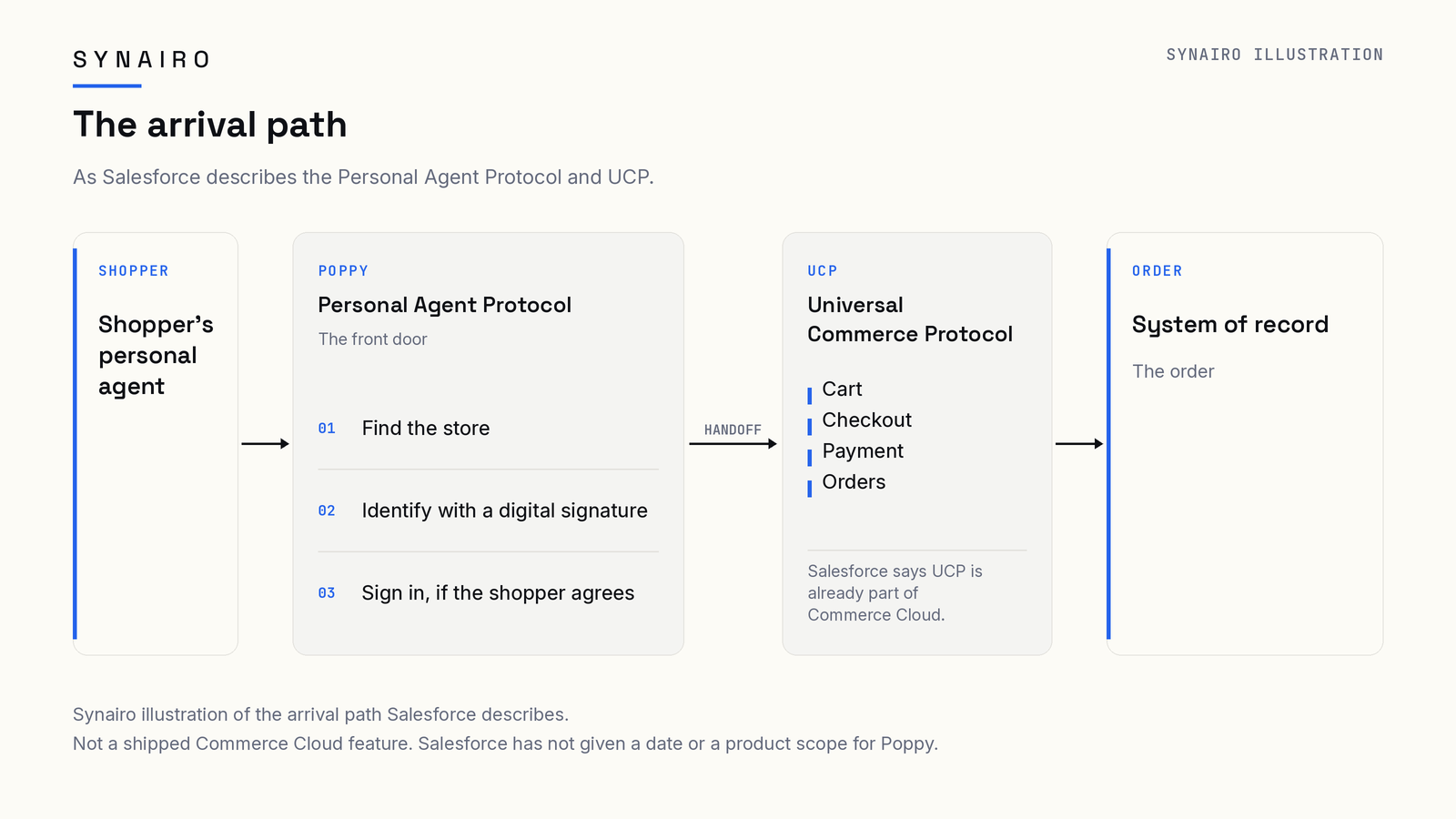
The arrival path as Salesforce describes it: Poppy covers find, identify, and sign in; cart, checkout, payment, and orders are handed to UCP. Synairo illustration — not a shipped Commerce Cloud feature.
This matters because a handoff is an integration boundary. An agent that has just signed in under Poppy still has to be recognized on the UCP side: which shopper, which account, which allowed actions, and which identifier is allowed to travel with the request. If those two halves disagree about identity or scope, you get a guest cart you cannot attach, a payment you cannot attribute, or an order you cannot audit.
Salesforce's stated intent is to bring Poppy to Commerce Cloud on top of that UCP foundation, so that more shoppers' agents could reach a commerce path that, in Salesforce's words, would stay the same. Until there is a dated product scope, treat that as a direction of travel, not as a topology you can already buy.
Is the Personal Agent Protocol available in Commerce Cloud?
No. On 16 November 2026 Salesforce wrote that its intent is to bring Poppy to Commerce Cloud on top of its UCP foundation, and that it will share more as plans take shape. There is no date, no edition, no org-level feature name, and no stated scope for what would actually ship.
Sierra's 13 November 2026 announcement lists Salesforce, "including Fin, Commerce Cloud, and Agentforce," among more than 100 design partners, and it reports that some other companies are already live — for example, that Shopify has enabled Poppy for every merchant on its platform. Sierra's term is "design partner"; Salesforce's own term is "launch partner." Neither listing is evidence that Fin, Commerce Cloud, or Agentforce already implement Poppy. A design partnership and a generally available feature are different things. Do not read coverage of Shopify, Muse, or other live implementations as a Commerce Cloud release.
Until Salesforce publishes a product scope, a Commerce Cloud architect's job is not to "turn Poppy on." It is to decide how the org would behave if an authenticated personal agent arrived tomorrow — and which of those decisions are already missing from the current storefront, identity, and order design.
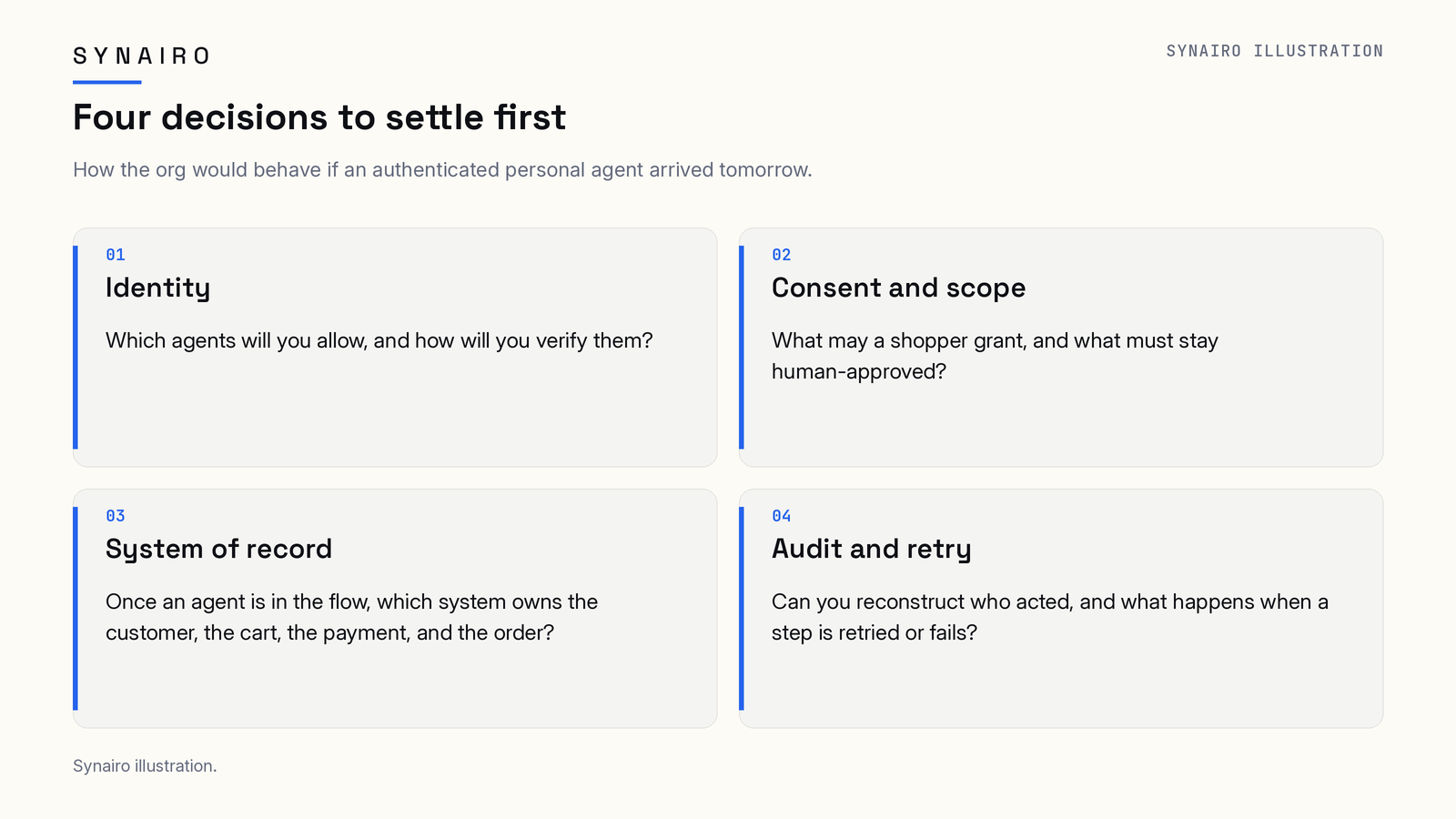
Four decisions to settle first if an authenticated personal agent arrived tomorrow: identity, consent and scope, system of record, and audit and retry. Synairo illustration.
Which agents will you allow, and how will you verify them?
Salesforce is explicit that Poppy does not tell a merchant which agents to let in. The company's stated principle for Commerce Cloud is that customers should be able to accept the agents they trust and turn the rest away — including limiting access by use case, or blocking agents that do not meet their standards — without waiting for a protocol or a platform to decide for them. Each agent identifies itself with a digital signature.
That leaves the policy with you. Before an agent reaches a signed-in account, decide:
- Who owns the allow and deny decisions — security, legal, commerce operations, or a named combination — and how often the list is reviewed.
- How the digital signature is verified at the edge you actually control: the storefront, an API gateway, or both. A signature you cannot verify is not an identity.
- What happens to an agent that has no signature, a signature you cannot validate, or a signature that is valid but not on your list. "Treat it like a bot" and "allow it as a guest" are different outcomes, and they need to be written down.
- What you log. If you cannot later say which agent presented which signature at which door, you do not have an identity control, you have a hope.
Do not use a launch-partner press list as a trust policy. The protocol, as Salesforce describes it, is a way to recognize an agent, not a recommendation to admit it.
What may a shopper grant, and what must stay human-approved?
Poppy, in Salesforce's description, keeps the shopper in control of the account. When a shopper wants to use their account, they sign in on the brand's own login page. The agent never receives their password. It gets only the access the shopper approves, and the shopper can revoke that access at any time. A store sees a private ID for each shopper. The protocol can recognize a returning customer, but stores cannot compare those IDs to track people across companies.
Sierra and Meta describe the sign-in model as OAuth. Salesforce's article does not use that word. Design as if you will be asked to support a brand-hosted login, a constrained grant, and revocation; do not assume a particular token profile until Commerce Cloud documents one.
The architectural work is to make the grant match the actions you are actually willing to automate:
- Separate scopes for reading an account, changing a cart, placing an order, and completing a payment. A single "use my account" permission is how an agent inherits more power than the shopper understood.
- Decide which of those actions may proceed on a standing grant, and which must come back to a person: a cart change, a payment, an order. Stay inside those three, which are the UCP moments Salesforce names. Do not invent protocol support for adjacent processes, such as returns, that the cited sources do not describe for this handoff.
- Define how revocation is enforced — not only on the login session, but on any downstream token, cart, or in-flight payment that was created under the grant.
- Keep the guest path and the signed-in path distinct. An agent that has not been granted account access should not pick up a recognized shopper ID by accident.
Consent that cannot be explained to the shopper, or revoked in a system you operate, is not a control.
Once an agent is in the flow, which system owns the customer, the cart, the payment, and the order?
An authenticated agent is a new actor on existing objects. It does not invent a new system of record, and it should not be allowed to blur the ones you already have. This is the same discipline Synairo already applies to Salesforce–ERP integration (opens in a new tab): write down which system owns which object, in which direction, and what happens when two systems disagree.
For a Commerce Cloud storefront that might one day accept a Poppy sign-in and a UCP transaction, make the ownership explicit:
- Customer. The private shopper ID that Poppy exposes is for recognizing a returning customer at that store. Salesforce says those IDs cannot be compared across companies. Do not use them as a global person key, and do not quietly merge them into a CRM or CDP identity graph as if they were a portable customer number. Decide how that store-private ID relates to the Commerce Cloud account, and which of those is allowed to update the profile.
- Cart. If the agent can mutate a cart, which system is the authority for cart state — the storefront, an OMS, or something in between — and how is an agent-attributed change distinguished from a shopper sitting at a browser?
- Payment. Payment is a UCP moment in Salesforce's split. Name the payment service provider, the system that stores the payment agreement, and the system that is allowed to request a capture. An agent should not be able to create a payment in a system that the rest of the order flow cannot see.
- Order. When the agent-assisted checkout completes, which system is the system of record for the order, and which systems receive a copy? If orders already flow from Commerce Cloud into an ERP, an agent-originated order has to follow the same ownership, the same business keys, and the same reconciliation path as any other channel.
The Poppy-to-UCP handoff is the place these decisions will fail first. The identifier that proved the agent and the shopper at the door has to mean the same thing when the cart is priced and the order is written. If it does not, you will spend the next incident trying to decide whether you have a guest order, a duplicate, or a customer you cannot support.
Can you reconstruct who acted, and what happens when a step is retried or fails?
If you cannot reconstruct who acted, you cannot support the order, revoke the right grant, or explain the payment. For each agent-assisted journey, you should be able to answer, from your own logs and not from a vendor dashboard you do not control: which agent presented a signature, which shopper signed in, what scope was granted, which UCP operation followed, and which payment attempt, if any, was made.
Then design the failure path with the same seriousness as the happy path — the rule Synairo already uses for enterprise integrations (opens in a new tab). At minimum, decide what happens when:
- Sign-in fails, is abandoned, or succeeds in Poppy but is not recognized on the UCP side.
- A grant is revoked while a cart or a payment is already in flight.
- A UCP handoff times out, is retried, or is delivered twice.
- A payment is requested twice for the same shopper intent.
Retries are normal. Duplicate orders and duplicate captures are not. Give the handoff an idempotency key that identifies the operation, not only the shopper or the cart, and make the writer of the order and the payment idempotent on that key. That is the same control that prevents most integration incidents on more ordinary Salesforce interfaces; it does not become optional because the caller is an agent.
Finally, name the person who will be paged, and instrument the path so a first responder can see what failed, for which record, and what is safe to replay. An agent channel you cannot operate is not a channel. It is a demo.
The protocol explains how an agent arrives. It does not tell you whether your org is ready to let one act.
Frequently asked questions
Is the Personal Agent Protocol already available in Salesforce Commerce Cloud?
No. In its 16 November 2026 announcement, Salesforce said its intent is to bring Poppy to Commerce Cloud on top of its UCP foundation, and that it will share more as plans take shape. It did not publish a date or a product scope.
What is the difference between Poppy and UCP?
In Salesforce's description, Poppy covers the first steps of an agent's visit: finding the store, proving identity, and signing into the shopper's account with their consent. Cart, checkout, payment, and orders are handed to the Universal Commerce Protocol.
Does being a launch partner mean Commerce Cloud merchants can turn this on?
No. Salesforce joined as a launch partner. That is not the same as a generally available feature in a Commerce Cloud org.
Do shoppers give their password to the personal agent?
No. Salesforce says shoppers sign in on the brand's own login page. The agent receives only the access the shopper approves, never the password, and the shopper can revoke that access at any time.
Who decides which agents a store accepts?
The merchant. Salesforce says the protocol does not tell merchants which agents to let in, and that Commerce Cloud customers should be able to accept the agents they trust and turn the rest away.
Can stores use the Poppy shopper ID to track a person across brands?
No. Salesforce says a store sees a private ID for each shopper, and that stores cannot compare those IDs to track people across companies.
Sources and further reading
Primary source, checked on 18 November 2026:
- Jon Stahl, "Salesforce joins the Personal Agent Protocol to help brands meet shoppers' AI agents," Salesforce, 16 November 2026. salesforce.com/blog/salesforce-joins-personal-agent-protocol (opens in a new tab)
Supporting sources, checked on 18 November 2026:
- Bret Taylor and Clay Bavor, "Releasing Personal Agent Protocol 1.0," Sierra, 13 November 2026. sierra.ai/blog/releasing-poppy (opens in a new tab)
- Johan Duramy, "More Ways for Muse to Work With Businesses," Muse, 13 November 2026. muse.ai/blog/poppy-personal-agent-protocol (opens in a new tab)
Related Synairo notes:
- Agentforce, Data Cloud and the EU AI Act: what actually changed for Salesforce teams (opens in a new tab) — production readiness for Salesforce AI is a use-case-specific engineering and governance decision, not a property of a product name.
- Salesforce ERP integration patterns: ownership, events, and failure recovery (opens in a new tab) — system-of-record boundaries, idempotent writes, and retry design.
Dealing with this in your own org?
If this is landing on an existing Commerce Cloud org and you want an engineer to walk through the implications, write to us at synairo.com/contact (opens in a new tab). The address reaches both of us, and the reply comes from whichever of us knows the answer.